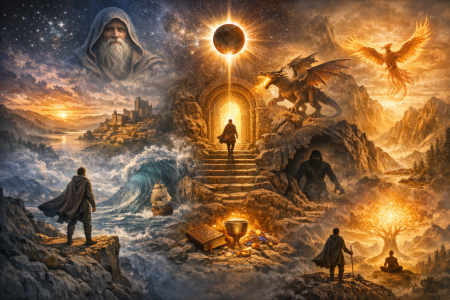
In all written and oral narratives, myths, and legends of humanity, there is a recurring theme: "The Hero's Journey." This archetype reflects the cycle at the core of life, the mysterious journey of existence, and the inner quest of the human being. Detailed and popularized by Joseph Campbell, this universal narrative reveals the process of ascension and transformation for both the individual and the collective consciousness.
The Hero’s Journey symbolizes not just a physical adventure, but a process of spiritual discovery. In essence, this odyssey is the evolutionary journey of the soul; a path extending from the known to the unknown, from the ordinary to the extraordinary, and from darkness to light—a relationship between man, his own essence, and the meaning of life.
Our story begins with a deficiency or imbalance in our world, which turns into a quest to remedy this void through an inner calling. We leave our familiar and comfortable world to step courageously into the unknown. While this process allows our new talents and knowledge to emerge, it also requires us to face our shadows and mature through hardships.
This is how the "Hero's Journey" begins: with a call. This call sometimes manifests as embarking on a physical adventure, and sometimes as the spark of an internal inquiry. Inner restlessness, dissatisfaction, or the feeling that something is missing encourages the individual to go beyond familiar boundaries. However, initially, this call is often refused. The fear of the unknown triggers our dependency on the safe and the familiar. The rejected call pushes the person into a deeper search, and this process actually paves the way for a greater transformation by presenting internal and external obstacles.
Subsequently, the individual becomes ready for the next crucial stage: meeting the mentor. The mentor is a figure—sometimes a person, sometimes a teaching, and sometimes a purely symbolic element—who provides wisdom, guidance, and inspiration. Through the mentor, the individual finds the courage within, realizes their potential, and discovers their true power.
If the individual can cross this threshold, they have entered a point of no return. Leaving everything familiar behind, they step into the unknown. We could call this Point Zero; the thin line where we sacrifice and reset all our idols, belief patterns, ego, vices, and addictions. Beyond the border lies the beginning of our existential journey.
This path is filled with numerous trials, allies, and enemies, both internally and externally. The individual faces profound truths about themselves and the world. The tests endured, the enemies encountered, and the allies gained are the elements that shape and "cook" the hero. These struggles are necessary for the hero to mature spiritually and discover their inner strength. Each encounter takes the hero one step further and helps them understand their true nature. This is why building the right environment is vital at this stage. Here, a person either falls off the path or stays on it despite all trials, with the help of the right environment—namely, true friends.
As the journey progresses, the trials deepen. Allegorically, the hero begins to face their deepest, darkest cave—their greatest fears and darkest shadows. This inner cave tests the spiritual limits of the person. Everyone must eventually face this darkness. This is one of the most significant breaking points in the process of personal transformation. Those who manage to emerge from the cave have, in a sense, illuminated their own darkness.
With this purification, as the time comes to give birth to a great transformation, the individual exerts all their strength to kill their old self and identities, experiencing a spiritual rebirth. This is a new level of existence, much like a baby who no longer fits in the mother's womb transitioning into worldly life.
Hidden behind this is a treasure. This reward is not just a material object; it can be a profound enlightenment, knowledge, or spiritual peace. This reward is the pinnacle of the hero's journey and the recompense for all the hardships endured. However, at this point, the reward is no longer for the hero alone. They will return to use this knowledge and gained power for the good of others.
At this exact moment, with their newly acquired identity and wisdom, they return to the ordinary world to serve the whole as a representative of the Creator on this earth. This is a moment of resurrection, like the Phoenix rising from its ashes. The individual has now reached a level where everything in their life gains profound meaning, and they have discovered their life purpose and true identity.
The individual brings back this acquired inner light to offer healing to others and to shed light on their own journeys. The journey is complete, yet a new cycle is about to begin. Because the hero's journey is circular; though the traveler returns to where they started, and though the road is the same, the traveler is now different.
The Hero’s Journey is not just a story told in fairy tales or legends. It is an archetype hidden within all of us. In our own lives, each of us experiences this journey at different stages. Sometimes we refuse the call, and sometimes we avoid facing our fears. However, the hero within us always finds a way to direct us toward our true selves and the deep meaning of life. This is the cycle of the "Son of Adam's" journey; the odyssey of a lifelong quest and the return to one's own essence.